Storyboard
For this capstone project, I was tasked with designing and developing a comprehensive instructional solution that addressed a real-world workplace training need. I chose to create a self-paced coaching module focused on helping Enrollment Managers effectively coach Enrollment Representatives through financial aid conversations.
This portion of the project focused specifically on the storyboarding and instructional planning process used to translate the instructional strategy into a fully structured learner experience.
Tools Used
Articulate Storyline, Articulate Rise, Snagit, Microsoft PowerPoint
Time Spent
About 5 hours
Project Overview
The storyboard for Coaching Through Financial Aid Conversations served as the detailed development blueprint for the final e-learning module. The storyboard documented screen-by-screen instructional flow, learner interactions, visual layout considerations, narration and text placement, assessment alignment, and functionality requirements needed to build the course within Articulate Rise and Storyline.
The purpose of the storyboard was to fully map the learner experience before final development began. This included planning instructional sequencing, interaction functionality, learner feedback pathways, visual hierarchy, multimedia integration, and navigation behavior throughout the course.
Because this project included multiple custom Storyline interactions and scenario-based learning activities, the storyboard process became a critical step in organizing both instructional flow and technical development requirements.
Storyboard Process
The storyboard was structured to document both instructional intent and technical functionality throughout the course experience.
Instructional Flow and Screen Sequencing: Each lesson and screen was mapped in detail to ensure the instructional progression aligned with the learning objectives and desired learner outcomes. The storyboard documented transitions between lessons, knowledge checks, interactions, and scenario-based activities to create a cohesive learner experience.
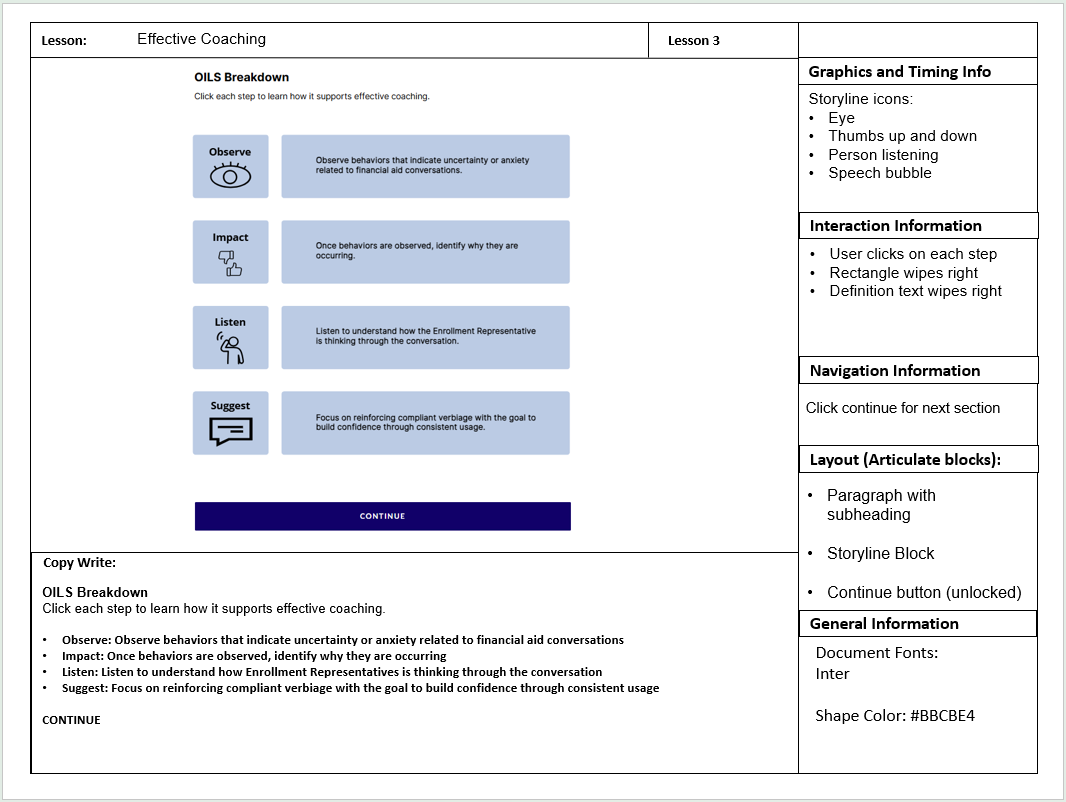
Interaction Planning: Detailed notes were included to outline learner interactions, button functionality, click states, feedback behavior, branching pathways, drag-and-drop activities, and scenario progression. Interactive Storyline activities were planned screen-by-screen to ensure that learner choices, feedback, and navigation aligned properly with instructional goals.
Multimedia and Visual Design Planning: The storyboard also included notes related to multimedia integration, visual layout, accessibility considerations, on-screen text, and graphic placement. Attention was given to visual hierarchy, chunking of information, and consistency across screens to support usability and reduce cognitive overload.
Scenario and Feedback Mapping: Scenario-based learning activities were fully mapped to document learner decision points, correct and incorrect feedback responses, remediation opportunities, and progression rules. This process ensured that all learner pathways supported coaching application and reinforced the intended learning objectives.
Assessment and Alignment Documentation: Knowledge checks and assessments were mapped directly to the learning objectives outlined within the design document. The storyboard documented assessment functionality, feedback language, scoring expectations, and learner progression requirements throughout the module.
Instructional Design Highlights
Developed a highly detailed storyboard documenting over 40 screens of instructional content, interactions, assessments, and scenario-based activities.
Planned custom Storyline functionality, including click-to-reveal interactions, sorting activities, drag-and-drop exercises, and branching coaching scenarios.
Created detailed learner feedback pathways to reinforce coaching concepts and support guided practice throughout the module.
Structured interactions to progressively increase learner independence, moving from guided recognition activities to learner-generated coaching responses.
Incorporated accessibility and usability considerations into screen layouts, navigation planning, and content sequencing.
Mapped all instructional activities directly to measurable learning objectives and workplace performance outcomes.
Designed realistic workplace scenarios that reflected authentic enrollment and financial aid coaching conversations.
Balanced instructional clarity with engagement by combining multimedia, interactivity, reflection, and application-based learning strategies.
Reflection
The storyboarding phase of this project reinforced the importance of detailed instructional planning before development begins. Because the final module included several custom Storyline interactions and scenario-based activities, the storyboard became essential for organizing instructional flow, learner decision-making, and technical functionality prior to development.
One of the most valuable aspects of this process was mapping learner interactions in detail before building them. Planning feedback pathways, interaction states, learner progression rules, and branching scenario outcomes helped ensure that each interaction served a meaningful instructional purpose rather than functioning as engagement alone.
This phase of the project also strengthened my ability to think simultaneously as both an instructional designer and developer. The storyboard needed to balance instructional goals, learner experience, technical feasibility, accessibility considerations, and development workflow all at the same time.
Ultimately, the storyboard process reinforced how critical detailed planning is when developing interactive e-learning experiences. It strengthened my ability to organize complex instructional experiences, align functionality with learning outcomes, and create development documentation detailed enough for another developer to fully build the course as intended.
See a sample of the completed Storyboard below!