Implementation and Evaluation Report
For this capstone project, I was tasked with designing and developing a comprehensive instructional solution that addressed a real-world workplace training need. I chose to create a self-paced coaching module focused on helping Enrollment Managers effectively coach Enrollment Representatives through financial aid conversations.
This portion of the project focused specifically on implementation planning, learner evaluation, assessment analysis, and iterative instructional improvement based on pilot feedback and learner performance data.
Tools Used
Microsoft Word, Canva, Brainshark
Time Spent
About 3 hours
Project Details
The Implementation and Evaluation Report documented the pilot rollout, learner feedback, assessment results, and proposed revisions associated with the Coaching Through Financial Aid Conversations instructional module. The report served as both an implementation reflection and an evaluation analysis, allowing me to examine the effectiveness of the instructional solution and identify opportunities for future improvement prior to broader organizational rollout.
This phase of the project focused heavily on learner performance, engagement data, transfer of learning, and instructional effectiveness. The report analyzed both quantitative and qualitative data collected through assessments, learner surveys, scenario-based activities, and pilot group feedback.
Because this project was designed around a real workplace coaching challenge, the implementation and evaluation process became an important opportunity to examine how learners responded to the instructional strategies, supporting resources, and scenario-based coaching activities included throughout the module.
Design Process
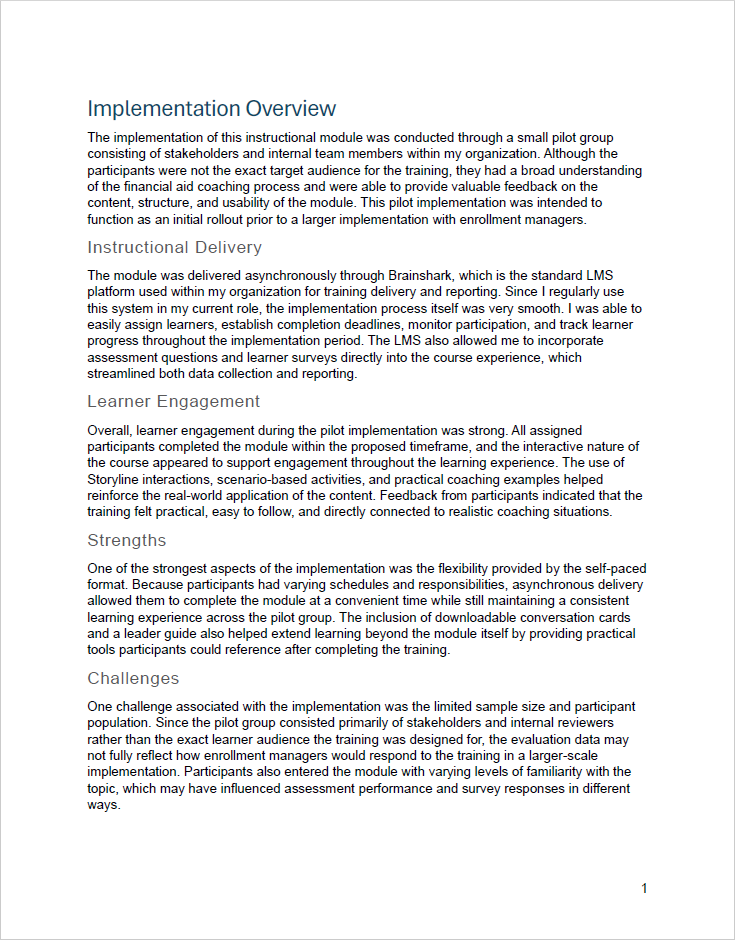
The report was structured around three primary areas: implementation overview, analysis of learner data, and proposed instructional revisions.
Pilot Implementation: The instructional module was implemented through a small pilot group consisting of stakeholders and internal team members within the organization. The course was delivered asynchronously through Brainshark, the organization’s standard LMS platform. This phase focused on monitoring learner participation, engagement, completion rates, and usability throughout the pilot rollout.
Assessment and Learner Evaluation: Learners completed pre- and post-assessments, participated in interactive scenario-based activities, and completed learner satisfaction surveys following module completion. Evaluation data was analyzed to identify changes in learner understanding, confidence, and coaching application.
Data Analysis and Interpretation: Assessment results, learner feedback, and survey responses were analyzed to identify instructional strengths, learner improvement trends, and opportunities for future revisions. Data analysis focused heavily on learner confidence, recognition of coaching opportunities, practical application of the OILS coaching model, and transfer of learning into workplace coaching situations.
Revision Planning: Based on learner feedback and evaluation data, recommendations were developed to strengthen future implementations of the training. Proposed revisions included additional practice opportunities, more advanced coaching scenarios, expanded coaching resources, and reinforcement activities designed to support long-term application and learner retention.
Instructional Design Highlights
Conducted a pilot implementation using a real organizational LMS environment and stakeholder feedback group.
Collected and analyzed both quantitative and qualitative learner data through assessments, learner surveys, and scenario-based activities.
Designed evaluation methods aligned directly to instructional objectives and workplace performance goals.
Created visual data representations to communicate learner performance improvements and satisfaction survey results.
Identified measurable learner improvement between pre- and post-assessment performance.
Used learner feedback to identify instructional strengths, usability considerations, and opportunities for future refinement.
Applied iterative instructional design principles by using implementation data to drive proposed revisions and future improvements.
Considered transfer of learning, reinforcement strategies, and long-term workplace application throughout the evaluation process.
Reflection
This phase of the capstone project significantly strengthened my understanding of implementation planning and instructional evaluation within workplace learning environments. While development is often the most visible phase of instructional design, this experience reinforced how important evaluation and iterative improvement are to creating effective learning solutions.
One of the most valuable aspects of this process was analyzing how learners interacted with the training and identifying patterns within both assessment data and learner feedback. The implementation process demonstrated that learner engagement alone is not enough to determine instructional effectiveness; evaluation data must also support measurable understanding, confidence, and application.
The pilot feedback also reinforced the importance of reinforcement and transfer of learning beyond the module itself. Although learners responded positively to the downloadable coaching resources and practical scenario activities, feedback suggested that additional reinforcement strategies may be necessary to ensure continued application within real workplace coaching situations.
This project also strengthened my ability to think more critically about instructional iteration and long-term improvement. Rather than viewing implementation as the final stage of the process, I began viewing it as an opportunity to gather insight, evaluate learner needs more deeply, and continuously improve the instructional experience over time.
Ultimately, this phase of the project reinforced the importance of data-informed instructional design and demonstrated how thoughtful implementation and evaluation processes can strengthen both learner outcomes and organizational training effectiveness.
See a sample of the completed report below!